County soil summary
Soil types in Escambia County, Florida
The most widespread soils are Troup, Poarch and Notcher; the most common drainage class is well drained (26% of the land), and typical topsoil pH is 5.3.
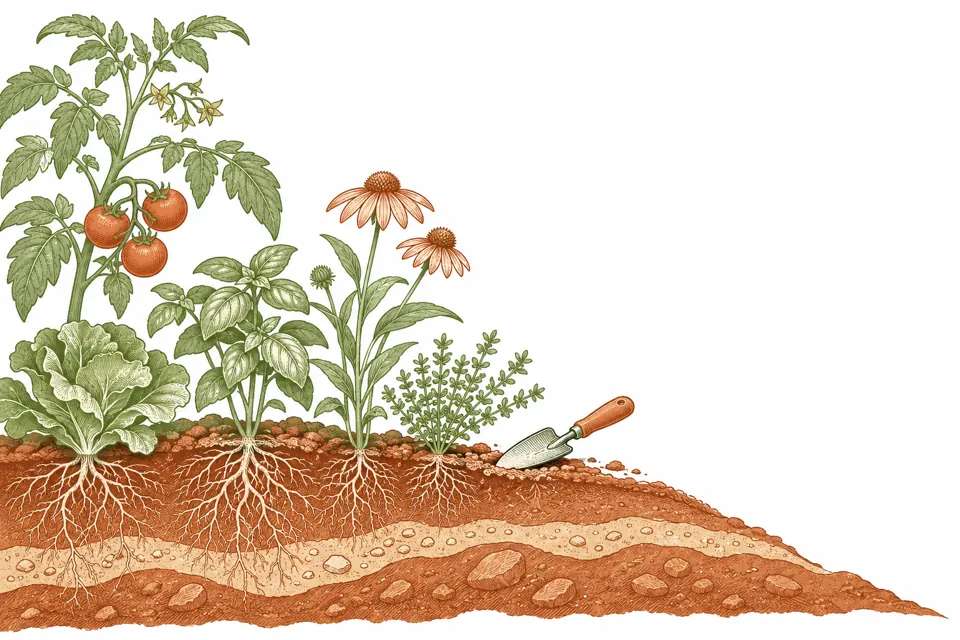
- Well or moderately well drained
- 66% of land · state 24%
- Typical topsoil pH
- 5.3 strongly acidic · state 5.3
- Septic fields very limited
- 75% of land · state 87%
- Subject to flooding
- 23% of land, any frequency · state 16%
Most common soils in Escambia County
Share of mapped land
A county is a patchwork of many soils. These 8 cover 64% of the mapped land; 56 named soil series are mapped here in all.
| Soil | Share of land | Drainage | Topsoil pH |
|---|---|---|---|
| Troup | 18.1% | Somewhat excessively drained | 5.3 |
| Poarch | 9.4% | Well drained | 5.0 |
| Notcher | 8.8% | Moderately well drained | 5.0 |
| Bonifay | 7.5% | Well drained | 5.3 |
| Lakeland | 5.9% | Excessively drained | 5.3 |
| Dorovan | 5.6% | Very poorly drained | 3.9 |
| FluvaquentsGeneral soil group, not a named series | 5.6% | — | — |
| Pelham | 3.2% | Poorly drained | 4.7 |
What this means
What the soils in Escambia County mean for gardens, lawns and septic systems
For your garden
Typical topsoil in Escambia County is strongly acidic: pH 5.3 (most land between 4.8 and 5.5). Most vegetables and lawn grasses do best around 6.0 to 7.0, so lime is often needed; blueberries, azaleas and rhododendrons like it as it is.
Sandy topsoil covers 75% of the land. It drains fast and warms early in spring, but dries out and loses nutrients quickly: mulch, compost and steady watering help. The most common surface texture is sand (36% of the land).
66% of the land is moderately well to excessively drained, which suits most garden plants.
For your lawn and yard
On 52% of the land, rain soaks in slowly (hydrologic groups C and D, including dual groups that are D until drained). Expect runoff and puddles after heavy rain: core-aerate compacted lawns and keep ground sloping away from foundations.
A seasonal high water table comes within 18 inches of the surface on 25% of the land, often in spring. Basements, sump pumps and lawns in low spots feel it first.
For a septic system
For conventional septic absorption fields, NRCS rates 75% of the land in Escambia County very limited, 23% somewhat limited and <1% not limited (2% not rated, such as urban land, pits or water).
Statewide, 87% of the land is very limited, so Escambia County is less restrictive than typical.
Where the soil is very limited (slow permeability, a high water table, flooding, shallow bedrock or steep slopes), alternative systems such as mound or sand-filter designs are common and cost more.
Flooding is mapped on 23% of the land (8% occasional, 14% frequent).
Only a licensed site evaluation or perc test at the actual lot decides whether a system is allowed and which design.
Drainage
How long the soil stays wet
The most common drainage class is well drained (26%). 66% of the land is moderately well drained or better, compared with 24% across Florida.
Show as a table
| Category | Escambia County | Florida |
|---|---|---|
| Excessively drained | 8.3% | 8.3% |
| Somewhat excessively drained | 17.2% | 1.3% |
| Well drained | 26.1% | 7.7% |
| Moderately well drained | 14.6% | 6.3% |
| Somewhat poorly drained | 9.8% | 8.1% |
| Poorly drained | 7.0% | 35.3% |
| Very poorly drained | 15.3% | 26.0% |
| Not rated | 1.6% | 7.1% |
Septic absorption fields
NRCS rating for conventional drain fields
The rating looks at the soil from 24 to 60 inches deep: permeability, depth to a seasonal water table or bedrock, flooding and slope. “Very limited” means at least one feature is unfavorable enough that a conventional field is hard to make work.
Show as a table
| Category | Escambia County | Florida |
|---|---|---|
| Not limited | 0.2% | 0.1% |
| Somewhat limited | 22.8% | 5.3% |
| Very limited | 75.3% | 87.4% |
| Not rated | 1.7% | 7.2% |
Rain, runoff and water table
Hydrologic soil group, flooding, seasonal water table
Hydrologic soil group
How fast rain soaks in when the soil is already wet. Group A soaks in fastest, D slowest.
Show as a table
| Category | Escambia County | Florida |
|---|---|---|
| A: fast infiltration (mostly sandy or gravelly) | 39.5% | 22.1% |
| B: moderate infiltration | 7.0% | 3.6% |
| C: slow infiltration | 14.0% | 1.8% |
| D: very slow infiltration (clayey, shallow or wet) | 9.2% | 2.5% |
| A/D: D as is, A if drained | 7.4% | 39.8% |
| B/D: D as is, B if drained | 13.0% | 13.3% |
| C/D: D as is, C if drained | 8.1% | 10.0% |
| Not rated | 1.7% | 6.9% |
Flooding
Show as a table
| Category | Escambia County | Florida |
|---|---|---|
| No flooding | 77.1% | 78.5% |
| Rare or very rare | 1.3% | 1.2% |
| Occasional | 7.7% | 2.0% |
| Frequent or very frequent | 13.5% | 13.1% |
| Not reported | 0.5% | 5.2% |
Seasonal high water table
Show as a table
| Category | Escambia County | Florida |
|---|---|---|
| Within 18 inches at some time of year | 25.0% | 62.3% |
| 18 inches to 3.3 feet | 19.1% | 8.8% |
| Deeper than 3.3 feet or none reported | 55.4% | 24.4% |
| Not reported | 0.5% | 4.5% |
Topsoil pH and texture
First mineral layer of each soil
Typical topsoil pH is 5.3 (strongly acidic); 80% of rated land falls between 4.8 and 5.5. Median topsoil organic matter is 1.2%.
Show as a table
| Category | Escambia County | Florida |
|---|---|---|
| Strongly acidic (below 5.5) | 80.1% | 53.6% |
| Moderately to slightly acidic (5.5–6.4) | 5.4% | 19.0% |
| Near neutral (6.5–7.3) | 5.7% | 4.6% |
| Alkaline (7.4 and up) | 0.0% | 3.6% |
| Not reported | 8.8% | 19.2% |
Texture
Show as a table
| Category | Escambia County | Florida |
|---|---|---|
| Sandy | 75.0% | 74.9% |
| Loamy (loam, silt loam and similar) | 16.1% | 5.1% |
| Clayey (40%+ clay) | 0.0% | 0.7% |
| Organic (muck or peat) | 7.1% | 12.4% |
| Not reported (rock, urban land, etc.) | 1.7% | 6.9% |
Sources & data dates
- Source
- USDA NRCS Soil Survey Geographic Database (SSURGO), queried through Soil Data Access. Public domain.
- Data date
- SSURGO as published on November 3, 2026 (most recent survey area update October 26, 2026). NRCS refreshes SSURGO each October.
- Scope
- Escambia County, Florida (FIPS 12033): 421,962 acres of mapped land, 59,638 acres of open water excluded. State comparisons pool all mapped land in Florida.
- Method
- Shares are by mapped land area: each map unit’s acres in the county times each soil component’s percentage. Open water is excluded. Topsoil values use the first mineral horizon of each component. Full methodology.