Guide · garden soil
What should I add to my garden soil?
Start with what your soil already is. Heavy clay, fast-draining sand and acidic or alkaline ground each need something different, and a few popular additions do nothing or make things worse. Compost is the one addition that helps almost every soil. For the rest, a soil test tells you what is actually missing.
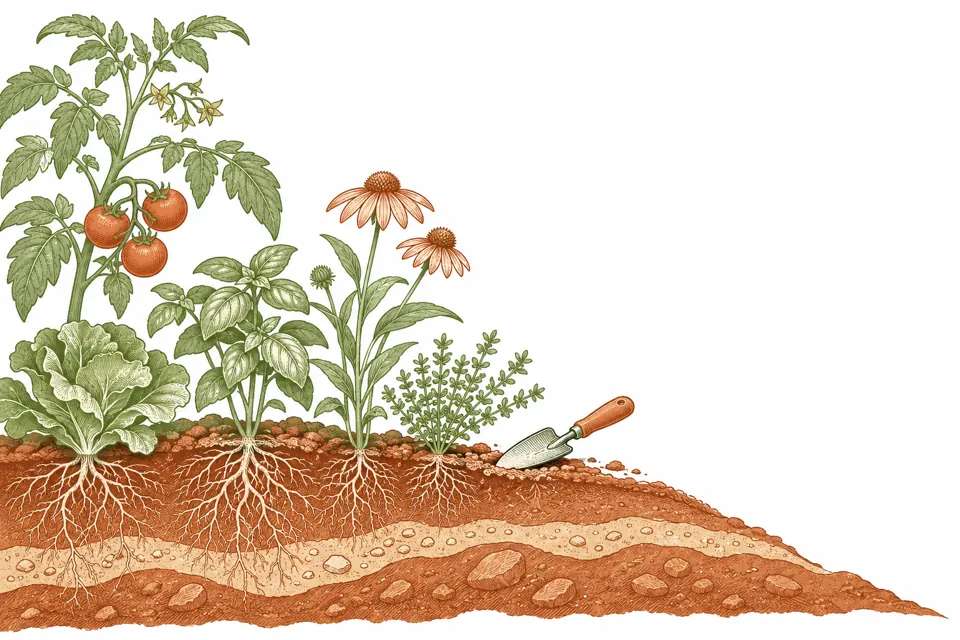
Start with a soil test and compost
A lab test reports pH and the main nutrients, and it comes with recommendations for how much lime, sulfur or fertilizer to add. Without one, adding nutrients is guesswork, and too much of some (phosphorus especially) is common in older gardens. Our ZIP lookup shows what the soil survey maps in your county: texture, drainage and typical pH, a useful starting point before the test comes back.
Compost improves clay (it loosens it and helps water move through) and sand (it holds water and nutrients). Two or three inches worked into a new bed, then an inch or so on top each year, is a common rule of thumb.
Should you add sand to garden soil?
Usually not, and almost never to clay. A University of Saskatchewan gardening guide explains that sand mixed into clay can form a concrete-like mixture, and that you would need sand making up roughly half the soil volume to change clay texture: about a truckload for a small bed. The problem with clay is poor structure, which compost and time fix and sand does not. See where clay soil is most common.
Should you add mulch to garden soil?
Put mulch on top of the soil rather than digging it in. A layer of shredded bark, wood chips, straw or leaves keeps moisture steady, keeps soil from crusting and slowly feeds soil life as it breaks down. The same Saskatchewan guide notes that an undisturbed 4-inch layer of arborist wood chips can make hard clay much easier to work within a few years.
Mixed into the soil, fresh wood chips and sawdust use up nitrogen while they decay, which can leave young plants pale. On top, they do not cause that problem.
Should you add perlite to garden soil?
Perlite is expanded volcanic glass: white, light and full of air. It is excellent in containers, seed-starting mixes and potting soil, where it keeps the mix from packing down. In an in-ground garden bed you would need a great deal of it to make a difference, it floats to the surface over time, and compost does a better job at a fraction of the cost.
Should you add vermiculite to garden soil?
Vermiculite is heated mica that holds water and some nutrients, the opposite job of perlite. It is useful in seed-starting mixes and for sandy container mixes that dry out fast. Like perlite, it is not a practical way to change a whole garden bed. For sandy ground that dries out, compost and mulch are the better fix; see where sandy soil is most common.
Should you add calcium to garden soil?
Only if a soil test says calcium is low or pH is too low. The most common reason gardeners reach for calcium is blossom end rot, the dark, sunken spot on the bottom of tomatoes. Iowa State University Extension explains that the fruit lacks calcium mainly because uneven watering stops the plant from taking it up, and that adding calcium to the soil is generally ineffective. Steady watering and mulch are the fix.
When a test does call for calcium, garden lime adds calcium and raises pH (right for acidic soil); gypsum adds calcium without changing pH.
How to add nitrogen to garden soil
Nitrogen drives leafy growth and is the nutrient most often short, especially in sandy soil and early in the season. Slow sources: compost, aged manure and cover crops such as clover, peas or beans, which can add nitrogen when their roots work with soil bacteria. Faster sources: blood meal, fish emulsion or a fertilizer with a higher first number on the bag.
More is not better. Iowa State lists high nitrogen fertilization among the causes of blossom end rot, and too much nitrogen gives big leafy tomato and pepper plants with little fruit.
Should you add leaves to garden soil?
Yes. Fall leaves are free organic matter. Shredded leaves (run a mower over them) make good mulch, compost quickly, or can be dug into empty beds in fall to break down over winter. Whole, unshredded leaves can mat down and shed water, so shred them first. Leaves left to rot in a pile for a year or two become leaf mold, a crumbly soil conditioner that gardeners prize.
How to add nutrients to garden soil
Compost and aged manure add a little of everything and feed soil life. For a specific shortage, a fertilizer bag lists nitrogen, phosphorus and potassium (N-P-K) in that order. University of New Hampshire Extension notes that many soils already hold plenty of phosphorus, and that you should not add more unless a test shows the need; phosphorus-free fertilizers exist for that reason. A soil test turns this from guesswork into a recipe.
How to add acid to garden soil (lower pH)
For blueberries, azaleas or alkaline ground, the standard material is elemental sulfur. University of Maine Cooperative Extension advises applying it in early spring and working it into the top 6 to 12 inches, because soil microbes have to convert it before pH drops; the change may show in the first season but more likely in the second. In strongly alkaline soils with free lime, sulfur fights a losing battle, and raised beds or containers are often easier. See typical soil pH in your state.
Sources
- University of Saskatchewan Gardening: Adding sand to clay soils is not recommended
- Iowa State University Extension: Blossom end rot
- University of New Hampshire Extension: Are garden soil test kits a good alternative to lab testing?
- University of Maine Cooperative Extension: What form of sulfur should we add to our vegetable garden to decrease the pH level?